
Nobody owns the water on the Moon - not yet, and not clearly, even as the world's major space powers spend billions of dollars racing toward it. That gap between ambition and law is becoming one of the more consequential open questions in space policy, because if ice buried in the Moon's permanently shadowed craters turns out to be as accessible as scientists hope, it could become far more valuable to whoever gets there first than any patch of lunar territory itself.
Where the Ice Is, and How We Know
Water ice on the Moon is believed to be concentrated in permanently shadowed regions (PSRs) near the lunar poles, especially the south pole, where crater floors never see sunlight and temperatures can fall to around -175°C, cold enough to trap water and other volatiles for billions of years. The idea dates back to a 1961 hypothesis, but the strongest evidence has accumulated over the past two decades: NASA's Lunar Reconnaissance Orbiter has detected hydrogen signatures and unusually low temperatures, and the Moon Mineralogy Mapper instrument - which flew aboard India's Chandrayaan-1 orbiter - confirmed the presence of water ice at the poles. NASA's 2009 LCROSS mission deliberately crashed a rocket stage into Cabeus crater and detected water in the resulting debris plume.
More recent research has refined this picture. A study led by researchers at the Weizmann Institute of Science, reported in April 2026, found evidence that ice has been gradually accumulating in the Moon's oldest south polar cold traps for at least 1.5 billion years. Separately, a July 2026 study published in Science Advances modeled how seismic waves could detect buried ice to depths of roughly 800 meters - a potentially cheaper way to map subsurface deposits ahead of crewed landings. It's worth being precise about what that study actually shows: it is a modeling and laboratory result, not a direct detection. No one has yet measured lunar ice directly at depth.
Why Water Matters More Than Territory
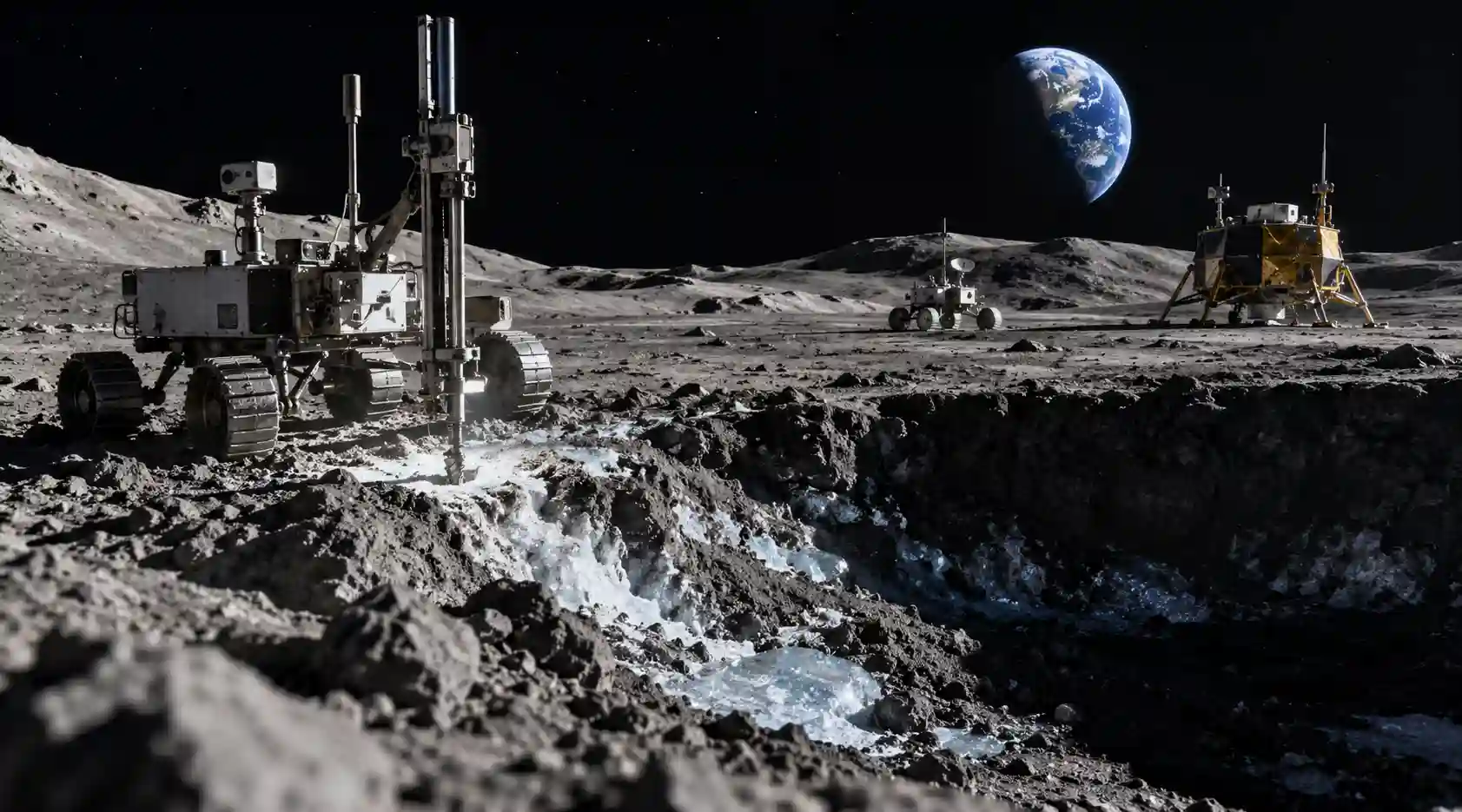
The scientific interest in lunar water is straightforward, but so is the practical one. If it can be extracted and purified, water ice could supply drinking water for astronauts, be split into hydrogen and oxygen for breathable air, and serve as a source of rocket propellant. That would let missions refuel on the Moon rather than hauling every drop of propellant from Earth. This is why NASA and other agencies now describe lunar water less as a scientific curiosity and more as strategic infrastructure - the resource that could make a permanent lunar presence, and eventual missions to Mars, financially and logistically viable.
Who Is Competing, and How
NASA's Artemis program is the most advanced Western effort, aiming to return astronauts to the lunar south pole specifically because of its ice deposits. The program's timeline has shifted repeatedly; NASA has revised Artemis III into a lower-risk demonstration mission, targeting Artemis IV (currently aimed at 2028) to actually put astronauts on the surface.
China and Russia are pursuing a parallel, state-led track. Beijing's China National Space Administration has laid out a phased International Lunar Research Station (ILRS) plan targeting the lunar south pole. Russia has ratified an agreement to build it jointly, with a basic station targeted by 2035. More than a dozen other countries have signed on to the ILRS framework.
India continues to pursue further lunar missions, while Japan's JAXA cooperates with NASA on Artemis elements. On the commercial side, companies including Intuitive Machines, Astrobotic, and Japan's ispace have flown or are developing landers explicitly aimed at prospecting for water ice.
What Space Law Actually Says
The foundational legal document is the 1967 Outer Space Treaty. Its Article II states that outer space, including the Moon, "is not subject to national appropriation by claim of sovereignty, by means of use or occupation, or by any other means." No country can legally claim the Moon as its territory.
What the treaty does not clearly settle is whether extracting and using a resource counts as "appropriation." The United States addressed this ambiguity domestically through its 2015 Commercial Space Launch Competitiveness Act, which grants US citizens the right to own, transport, use and sell resources they extract from celestial bodies. Luxembourg, the UAE, and Japan have passed broadly similar national laws.
The Artemis Accords, backed by more than 70 countries as of mid-2026, build on that interpretation at a multilateral level. Signatories affirm that resource extraction does not constitute national appropriation and commit to establishing "safety zones" around operations. Crucially, the Accords are political commitments, not a binding treaty.
This interpretation is contested. Critics argue that allowing extraction without an international framework effectively privatizes a shared resource. China and Russia have not signed the Artemis Accords and have pursued their separate ILRS framework.
Why Access May Matter As Much As Law
Because a relatively small number of PSR craters near the south pole are believed to hold the most accessible ice, and sit near permanently sunlit rims valuable for solar power, the practical geography of the lunar south pole is limited. Analysts note that whoever establishes landing pads, habitats, and power systems at the most favorable sites first could gain outsized influence over who else can operate nearby - not through legal ownership, but through the practical reality of occupying the best real estate and invoking safety zones to keep other operators at a distance.
Is Lunar Water Mining Economically Realistic Today?
Not yet, by any independent account. No mission has directly extracted, processed and used water from lunar ice. Turning ice into usable water, oxygen or fuel on the Moon requires excavation equipment that can operate in extreme cold and near-vacuum conditions, and power sources adequate for continuous operation through long lunar nights - none of which has been demonstrated at scale. For now, lunar water's economic case rests on its potential to reduce the cost of future government exploration missions rather than on a demonstrated commercial market.
What Could Trigger Disputes
Given the small number of prime sites, overlapping national programs, and a legal framework that leaves the core extraction question genuinely unsettled between the US-led Artemis bloc and the China-Russia ILRS bloc, friction seems more a matter of when than if. Plausible flashpoints include competing claims to operate in or near the same crater, disagreements over how large an Artemis Accords "safety zone" can be, disputes over interference with infrastructure, and diverging national interpretations of what counts as legitimate resource use versus appropriation. None of these disputes has yet occurred in a concrete form - they remain foreseeable risks flagged by legal scholars and policy analysts.
Further reading and useful links
Reader questions
Frequently asked questions
Who legally owns the water on the Moon?
Legally, nobody. The 1967 Outer Space Treaty forbids national appropriation of the Moon. However, the U.S. and allies argue under the Artemis Accords that extracting and using resources does not violate this treaty, a view contested by other nations.
Why is water ice on the Moon so valuable?
Water ice can be purified for drinking, or split into hydrogen and oxygen to provide breathable air and rocket propellant. This would allow missions to refuel in space, drastically cutting the cost of deep-space exploration.
Where is the water on the Moon located?
The strongest evidence points to water ice being trapped in permanently shadowed regions (PSRs) near the lunar poles, primarily the south pole, where temperatures are cold enough to trap volatiles for billions of years.
Nexuswild welcomes factual corrections. Email [email protected] with evidence and the article URL.