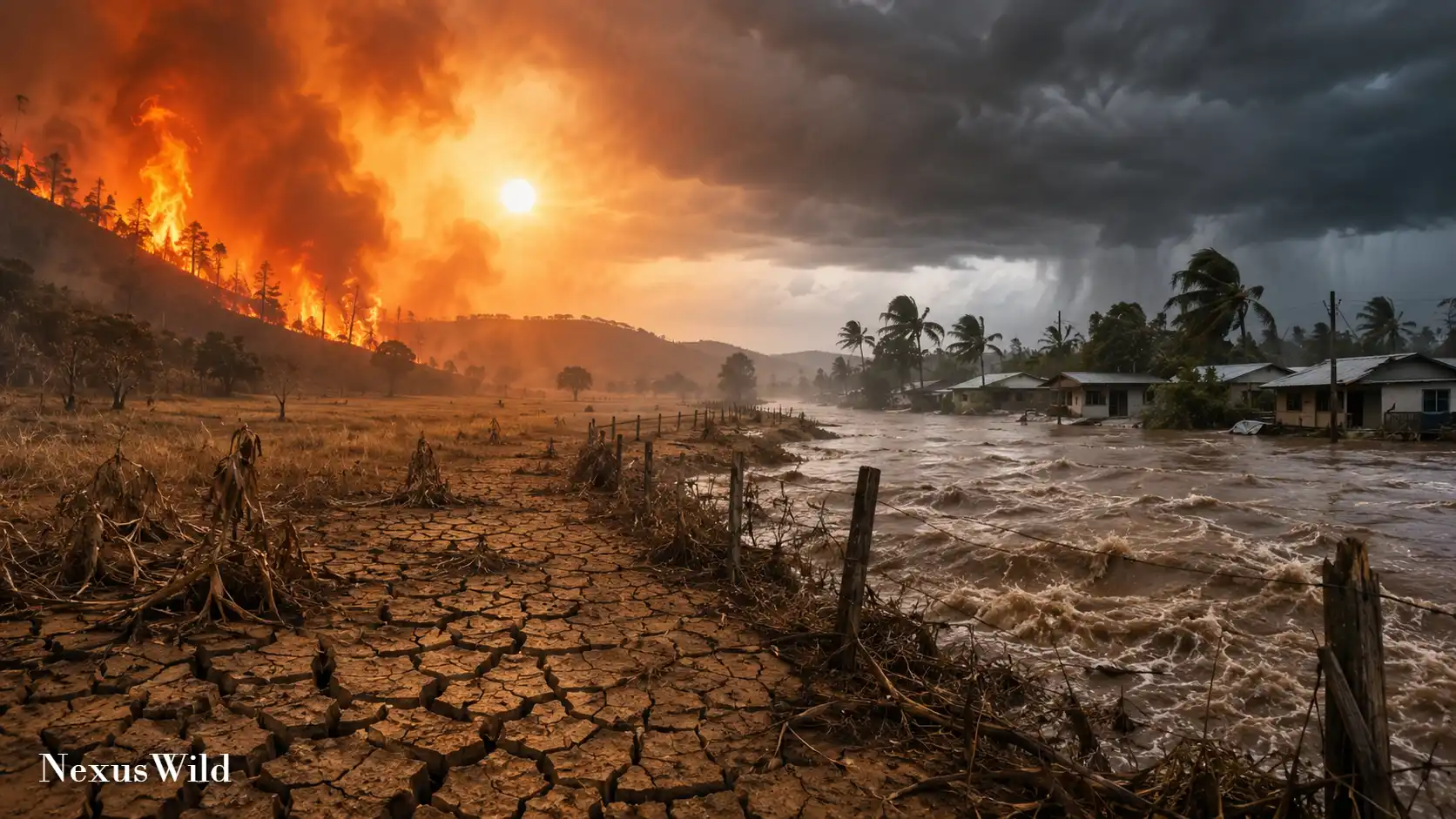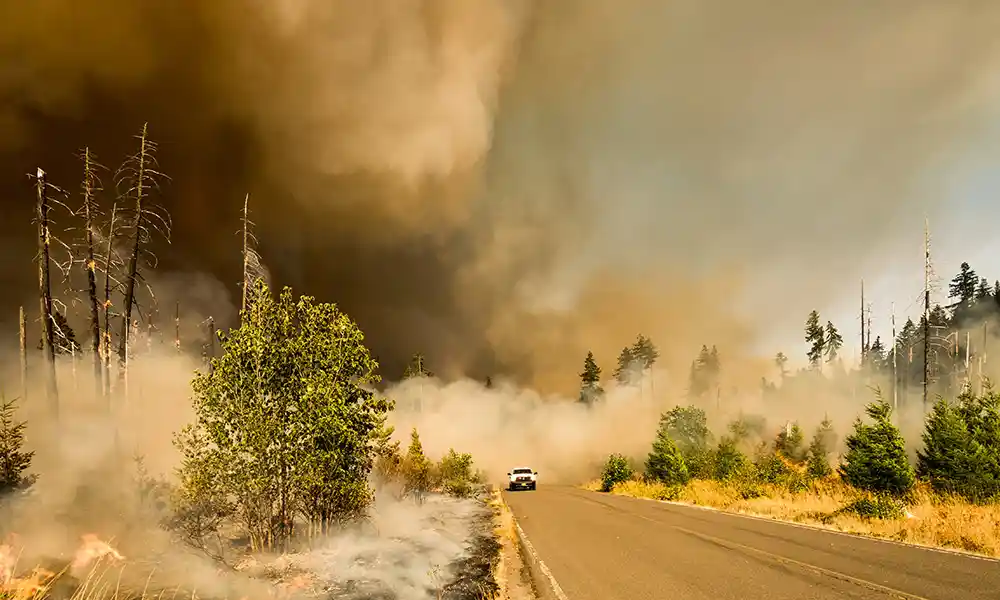

Extreme weather events and mounting climate-related risks continue to shape communities, economies, and ecosystems worldwide, according to the latest assessments from international scientific and humanitarian organizations. From record ocean heat content to a sharp rise in wildfire and storm losses, recent data from the World Meteorological Organization (WMO), the UN Environment Programme (UNEP), and major reinsurers point to a climate system under sustained strain, even as global disaster losses eased somewhat in 2025 compared with the previous year.
This article reviews the latest verified climate data, the scientific basis linking climate change to extreme weather, the documented impacts on people and economies, and the state of international mitigation and adaptation efforts, distinguishing throughout between observed data, expert assessment, and policy commitment.
Latest Extreme Weather Trends
The WMO's State of the Global Climate 2025 report, released on March 23, 2026, confirmed that 2025 ranked as the second or third warmest year in the 176-year observational record, depending on the dataset used, with a consolidated global average surface temperature of about 1.44°C, plus or minus 0.13°C, above the 1850-1900 pre-industrial baseline. The report confirmed that the years 2015 to 2025 were, individually, the eleven warmest years on record, and that 2023 to 2025 were the three warmest years, with a three-year average of 1.48°C above pre-industrial levels.
The report identified the Earth's energy imbalance as a headline indicator for the first time, noting it reached a record high in 2025, with more than 90 percent of that excess heat stored in the ocean. WMO said the ocean has been absorbing heat equivalent to about eighteen times annual human energy use each year over the past two decades. Sea levels were recorded at approximately 11 centimeters higher than in 1993. Arctic sea ice extent after the winter freeze was the lowest or second-lowest on record, while Antarctic sea ice extent has seen its four lowest years on record occur within the past four years. Among long-term reference glaciers, eight of the ten most negative annual mass-balance years since 1950 have occurred since 2016.
Regional data compiled by reinsurer Swiss Re shows Europe now experiences an average of 21 to 26 days per year with temperatures of 30°C or higher, based on 2016-2025 data, compared with 10 to 17 such days in the 1950s, a 64 percent increase in long-term decadal averages. In India, monsoon rains arrived later than usual in 2026 and remained weaker than normal, according to Munich Re's mid-year disaster review, which also noted that strengthening El Niño conditions had heightened drought-related risk in parts of Asia.
Global Climate Risks
Scientific assessments distinguish between long-term climate trends, which are attributed with high confidence to human-caused greenhouse gas emissions, and individual extreme weather events, where the strength of the climate change link varies by hazard type. Heatwaves show the strongest and most consistent attribution to climate change in the scientific literature, given the direct physical relationship between rising baseline temperatures and the frequency and intensity of extreme heat. Munich Re's chief climatologist, Tobias Grimm, commenting on the reinsurer's disaster data, said plainly that "the world is hotter than ever before," and that this was contributing to stronger storms and more severe flooding, while cautioning, in the same assessment, that not every individual storm can be directly attributed to climate change.
For other hazards, including heavy rainfall, droughts, and wildfire conditions, scientific organizations generally describe climate change as an amplifying factor that increases the likelihood or intensity of events driven by natural variability, rather than a sole cause of any single event. Swiss Re's research separately notes that rising temperatures act as a multiplier of other hazards, creating conditions more conducive to drought, wildfire, and, in some regions, flash flooding, in addition to direct effects such as reduced agricultural productivity, strained water and energy systems, and lower labor productivity.
Impact on Communities, Economies and Ecosystems
Global natural disaster losses totaled an estimated $224 billion in 2025, according to Munich Re, a nearly 40 percent decline from 2024's $320 billion, which the reinsurer attributed largely to the absence of a major U.S. mainland hurricane landfall rather than any underlying reduction in risk. Munich Re recorded approximately 17,200 disaster-related deaths in 2025 and put insured losses at $108 billion for the year. Separately, Swiss Re Institute calculated global insured natural catastrophe losses at $107 billion for 2025, close to Munich Re's figure, and noted that wildfires, severe convective storms, and floods, together known as secondary perils, accounted for a record 92 percent of global insured losses that year.
The costliest single disaster of 2025 was the January wildfire outbreak in Los Angeles County, which Munich Re estimated caused $53 billion in total economic losses and around $40 billion in insured losses, making it, according to Swiss Re, the costliest wildfire event on record. Swiss Re also reported that insured wildfire losses have been growing at an estimated 12 percent per year, describing wildfire as the fastest-growing peril it tracks, while flood-related insured losses in 2025, at $3.4 billion globally, were well below the prior five-year average of $15.4 billion. In the first half of 2026, global economic losses from natural catastrophes eased further, to about $100 billion to $112 billion depending on the source, according to separate estimates from Swiss Re and Munich Re, both below the equivalent period in 2025 and below respective ten-year averages, though both reinsurers cautioned that later-year hurricane and wildfire activity typically drives a large share of annual losses.
Beyond direct disaster losses, climate-related stress is affecting broader economic systems. Citing a 2018 study, Australia's National Climate Risk Assessment estimated that heatwaves are already reducing that country's labor productivity by up to approximately 0.5 percent, translating into billions of dollars in economic impact. On ecosystems, the WMO's 2025 climate report linked continued ocean warming and acidification, glacier retreat, and diminishing sea ice to disruption of marine and polar ecosystems, while sea-level rise was cited as a driver of coastal ecosystem damage, groundwater salinization, and increased coastal flooding risk.
International Climate and Environmental Action
The 30th UN Climate Change Conference (COP30), held in Belém, Brazil, from November 10 to 21, 2025, took place against this backdrop of intensifying climate data. Ahead of the conference, UNEP's Emissions Gap Report 2025, titled "Off Target," found that full implementation of countries' Nationally Determined Contributions (NDCs) would put the world on track for 2.3 to 2.5°C of warming by the end of the century, an improvement from the 2.6 to 2.8°C projected in the prior year's report, while continuation of current policies alone would lead to up to 2.8°C of warming, down from a projected 3.1°C previously. The report noted that global greenhouse gas emissions had continued to rise, reaching 57.7 gigatons of CO2-equivalent in 2024, an increase of 2.3 percent year-on-year.
By the close of COP30, 119 countries, representing 74 percent of annual global emissions, had submitted new NDCs, though UNEP-linked analysis found these commitments would deliver only around 11 percent of the emissions reductions needed by 2035 to remain consistent with the 1.5°C goal, and 17 percent of the reductions needed for the 2°C goal. UN Secretary-General António Guterres, in a statement accompanying the Emissions Gap Report, said the reduced warming projection represented progress but added, "that is progress, but nowhere near enough," noting that scientists now consider a temporary overshoot of the 1.5°C threshold, beginning as early as the start of the 2030s, all but unavoidable. Guterres called for COP30 to advance mobilization of $1.3 trillion a year in climate finance for developing countries by 2035, a target tied to commitments made at the prior COP29 conference.
On the mitigation side, deployment of renewable energy has continued to expand. According to the International Renewable Energy Agency's (IRENA) Renewable Capacity Statistics 2026, published April 1, 2026, global renewable power capacity reached 5,149 gigawatts by the end of 2025, following the addition of 692 gigawatts of new capacity during the year, a 15.5 percent annual increase. Renewable sources accounted for 85.6 percent of all new power capacity added globally in 2025, with solar power contributing 511 gigawatts, or roughly three-quarters of total renewable growth. IRENA reported that Asia accounted for 74.2 percent of new renewable capacity in 2025, led by China's addition of 440.1 gigawatts, while Africa recorded its highest-ever annual increase, adding 11.3 gigawatts, driven by growth in Ethiopia, South Africa, and Egypt, and the Middle East saw its fastest growth on record, at 28.9 percent, led by Saudi Arabia. Despite this record pace, IRENA noted that current growth rates remain below the trajectory needed to meet the goal, adopted at COP28, of tripling global installed renewable capacity to more than 11 terawatts by 2030, a target that IRENA said would now require annual capacity growth of around 16.6 percent through the end of the decade.
Adaptation and Disaster Preparedness
Alongside mitigation, adaptation and disaster preparedness featured prominently in recent international assessments. UNEP's Adaptation Gap Report 2025 found that developing countries will need more than $310 billion annually by 2035 to adapt to climate impacts, while wealthy nations provided only $26 billion in adaptation finance to developing countries in 2023, the most recent year for which complete data was available. The report noted that a prior "Glasgow" commitment to double adaptation finance had expired in 2025, adding pressure on COP30 negotiators to agree a new, credible adaptation finance goal.
UNEP has also highlighted the cost-effectiveness of early warning systems, stating that every dollar invested in such systems can save up to fifteen dollars in avoided losses. The UN's Early Warnings for All initiative, launched by Secretary-General Guterres in 2022 with the goal of universal multi-hazard early warning coverage by the end of 2027, reported in 2025 that 119 countries were covered by a multi-hazard early warning system, a 113 percent increase since 2015. Progress has been notable in Africa, where coverage more than doubled from 10 countries with early warning systems in 2015 to 26 in 2026, and 41 African countries now report on some form of early warning system, with the comprehensiveness of those systems more than doubling since 2022, according to the UN Office for Disaster Risk Reduction (UNDRR). Progress on this initiative was reviewed at the Africa Early Warnings Forum, held in Addis Ababa, Ethiopia, from September 2 to 4, 2026, and organized jointly by UNDRR, WMO, the International Telecommunication Union (ITU), and the International Federation of Red Cross and Red Crescent Societies, alongside the African Union Commission, which drew more than 400 participants from over 50 African countries. Separately, ITU, which leads the initiative's pillar on warning dissemination and communication, reported that formal national roll-out workshops for the initiative had been conducted in at least 35 countries as of the third quarter of 2026, including Mozambique, Bangladesh, Somalia, Nepal, and several Pacific and Caribbean island states, reflecting continued, if uneven, expansion of the initiative's institutional groundwork beyond the headline coverage figures.
Scientific and Expert Views
Assessments from WMO, UNEP, and the reinsurance sector broadly converge on a consistent picture: long-term warming and its physical consequences, including ocean heat content, sea-level rise, and glacier and sea-ice loss, are well documented and tracking at or near record levels, while the translation of that warming into specific disaster losses in any given year remains subject to considerable natural variability. Swiss Re's Balz Grollimund, head of catastrophe perils at the Swiss Re Institute, characterized the below-trend natural catastrophe losses of 2025 as "the result of favorable variability rather than any easing of underlying risk," a distinction echoed across multiple assessments reviewed for this article between short-term loss fluctuations and longer-term structural risk trends.
UNDRR's Special Representative of the UN Secretary-General for Disaster Risk Reduction, Kamal Kishore, has separately underscored the human toll of individual extreme events, issuing statements on recent disasters including flash flooding and mudslides that struck Nepal and China in late August 2026, while calling for strengthened preparedness and anticipatory action in the face of growing El Niño-related impacts, according to UNDRR's own reporting.
Challenges and Remaining Gaps
Several gaps remain evident across the international response, based on the assessments reviewed. On mitigation, UNEP's own analysis found that submitted NDCs following COP30 covered only a fraction of the emissions reductions needed to meet either the 1.5°C or 2°C goals of the Paris Agreement, and only 60 of nearly 200 Parties to the agreement had submitted new NDCs with 2035 mitigation targets by the report's late-September 2025 cutoff, covering 63 percent of global emissions.
On adaptation finance, the gap between the estimated $310 billion in annual need by 2035 and the $26 billion actually provided in 2023 represents one of the starkest documented shortfalls in current climate policy. Negotiations over a proposed set of 100 indicators to measure progress under the Global Goal on Adaptation also met resistance at COP30 from a bloc of African countries, which argued the indicators were "intrusive" in tracking domestic policies and risked shifting responsibility from high-income to developing countries, illustrating ongoing disagreement over how adaptation progress should be measured and by whom.
On disaster preparedness, while early warning system coverage has expanded significantly since 2015, UN officials have noted that gaps remain particularly acute in small island developing states and least-developed and fragile countries, where coverage and system comprehensiveness lag the global average despite these countries often facing disproportionate climate risk. On the financial side, Munich Re's first-half 2026 disaster review found a 60 percent gap between total economic losses and insured losses globally, indicating that a majority of disaster-related financial losses worldwide are not covered by insurance, a gap reinsurers describe as a long-term structural vulnerability rather than a temporary condition.
Reinsurers have also cautioned against reading recent below-trend loss years as a sign of easing risk. Swiss Re projected that if insured natural catastrophe losses return to their long-term growth trend, driven by continued exposure growth in vulnerable areas, they could reach approximately $148 billion in 2026 and $186 billion by 2030, while a peak-loss scenario involving a major hurricane or earthquake striking a densely insured area could push 2026 insured losses as high as $320 billion. On renewable energy deployment, the pace of growth, while record-setting in absolute terms, also remains geographically uneven: IRENA's data shows small island developing states accounted for just 0.3 percent of global renewable capacity additions in 2025, underscoring persistent disparities in how the clean energy transition is proceeding across different country groupings, separate from the disparities already noted in adaptation finance and early warning coverage.
Conclusion
The latest climate and disaster data reviewed in this article point to a consistent pattern: long-term physical indicators of climate change, including global temperatures, ocean heat content, and sea-level rise, continue to reach or approach record levels, even as year-to-year disaster losses fluctuate with natural variability in storm and hurricane activity. International bodies including the WMO, UNEP, and UN disaster-risk agencies describe measurable progress in some areas, including narrowing (though not closing) the projected emissions gap and expanding early warning system coverage, alongside persistent and, in the case of adaptation finance, widening gaps between what is needed and what has been delivered. Both mitigation, reducing the greenhouse gas emissions driving long-term warming, and adaptation, strengthening preparedness and resilience to the impacts already underway, remain necessary and complementary components of the global response, according to the international assessments examined for this article, with neither approach alone sufficient to address the full scope of documented climate risk.
Further reading and useful links
Reader questions
Frequently asked questions
How warm was the year 2025 according to the WMO?
The WMO's 2025 report confirmed it was the second or third warmest year on record, at approximately 1.44°C above the pre-industrial baseline.
What were the total global natural disaster losses in 2025?
Global natural disaster losses totaled an estimated $224 billion in 2025, according to Munich Re, a decline from $320 billion in 2024, largely due to a lack of major U.S. mainland hurricane landfalls.
What is the current adaptation finance gap for developing countries?
Developing countries will need more than $310 billion annually by 2035 for climate adaptation, whereas wealthy nations provided only $26 billion in 2023.
Are current climate pledges sufficient to meet the Paris Agreement goals?
No. According to UNEP, post-COP30 emissions pledges would achieve only 11 to 17 percent of the reductions needed by 2035 to meet the 1.5°C or 2°C temperature goals.
Nexuswild welcomes factual corrections. Email [email protected] with evidence and the article URL.