
NEW DELHI, Sept. 17, 2026 - An Indian Navy warship and a Pakistan Navy vessel collided in the North Arabian Sea on September 15, roughly 220 kilometres east of Oman, triggering formal diplomatic protests from both governments and renewed scrutiny of a 35-year-old military safety agreement.
The collision is confirmed. Responsibility for it is disputed.
India says the Pakistani vessel approached a frontline Indian Navy warship at high speed during a routine surveillance mission in international waters and manoeuvred in an unsafe and unprofessional manner before the ships made contact.
Pakistan gives the opposite account. Its foreign ministry says the Indian vessel carried out aggressive manoeuvres close to a Pakistani naval ship while Pakistan was conducting its SEASPARK-26 exercise in what Islamabad describes as Pakistan's exclusive economic zone.
Both governments summoned the other's senior diplomat on September 16.
Neither side has publicly released a complete navigational reconstruction, bridge audio, radar track or independent accident investigation. The safest factual conclusion is therefore limited but important: two naval vessels from India and Pakistan made physical contact at sea during an already tense period, and each government blames the other for causing it.
What is confirmed
The encounter took place on the evening of September 15 in the northern Arabian Sea.
Indian officials place the collision around 120 nautical miles, roughly 220 kilometres, east of the Oman coast.
India says its ship was carrying out a routine surveillance mission.
Pakistan says its navy was conducting the biennial SEASPARK-26 exercise.
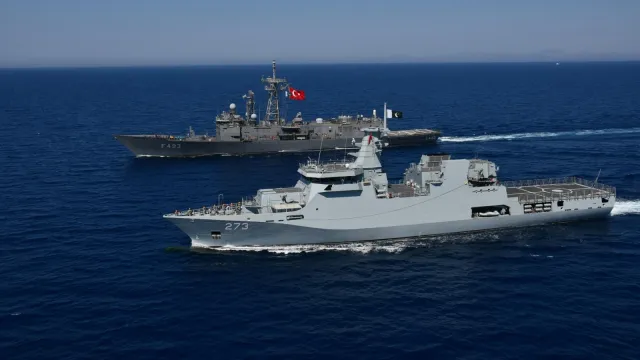
The Pakistani vessel has been widely identified as PNS Hunain, a modern offshore patrol vessel delivered to the Pakistan Navy in 2024.
Pakistan's official diplomatic statement does not name the ship.
The Indian Navy has not publicly identified its own vessel in the official material available for this report.
That is important because several names have circulated publicly, but they should not be treated as confirmed unless the Indian government formally identifies the ship.
India's account
India's Ministry of External Affairs summoned Pakistan's Charge d'Affaires in New Delhi on September 16 and lodged a formal protest.
According to India's public account, the Pakistani naval unit closed in on the Indian warship at high speed and handled its approach in an unsafe manner.
India says the contact occurred in international waters.
New Delhi also says the encounter breached Article 10 of the 1991 Agreement between India and Pakistan on Advance Notice on Military Exercises, Manoeuvres and Troop Movements.
That provision requires naval ships and submarines of the two countries not to close to less than three nautical miles from one another while operating in international waters.
Three nautical miles is about 5.6 kilometres.
India says the purpose of invoking Article 10 is straightforward: the rule was written specifically to reduce the risk of accidental collisions and escalation between the two navies.
India also instructed its Charge d'Affaires in Islamabad to lodge a corresponding protest.
Pakistan's account
Pakistan issued its own formal protest the same day.
Its Ministry of Foreign Affairs said the Indian vessel manoeuvred aggressively and dangerously close to the Pakistani ship during SEASPARK-26.
Islamabad says the incident occurred inside Pakistan's exclusive economic zone.
Pakistan also says the encounter violated the same 1991 bilateral agreement and international law.
Its foreign ministry summoned India's Charge d'Affaires in Islamabad and called the incident provocative and unacceptable.
This creates an unusual situation in which both governments are relying on the same bilateral confidence-building framework while accusing the other side of violating it.
The location dispute needs careful language
India describes the site as international waters.
Pakistan describes it as its exclusive economic zone.
Those descriptions are not necessarily mutually exclusive in the way they may sound.
Under the United Nations Convention on the Law of the Sea, an exclusive economic zone can extend up to 200 nautical miles from a coastal state's baseline.
An EEZ is not the same as territorial sea.
The coastal state has sovereign rights over resources and certain regulatory matters, but other states retain freedoms of navigation and overflight, subject to the convention.
So the legal issue is more complex than simply asking whether the ships were inside or outside Pakistan.
The more immediate bilateral safety issue is the distance between the vessels and how they manoeuvred before contact.
That is exactly what Article 10 of the 1991 agreement was designed to address.
What Article 10 actually says
India and Pakistan signed the Agreement on Advance Notice on Military Exercises, Manoeuvres and Troop Movements in New Delhi on April 6, 1991.
It entered into force in August 1992 and was later registered with the United Nations.
The agreement was created to reduce the risk that military exercises or movements would be misread as preparations for attack.
Its provisions cover land, naval and air forces.
For naval units operating in international waters, Article 10 establishes a three-nautical-mile separation rule between ships and submarines belonging to the two countries.
The rule is simple because the problem it addresses is simple.
Large military vessels have limited stopping distances.
They may carry weapons, fuel and aviation facilities.
A misjudged close approach can therefore produce consequences far beyond ordinary commercial shipping damage.
A three-nautical-mile buffer gives commanding officers more time and space to avoid a dangerous situation.
Why the collision is serious even without major damage
A naval collision does not have to sink a ship to become a national-security event.
The danger comes from ambiguity.
A ship closes distance.
The other ship changes course.
One bridge team may interpret a manoeuvre as unsafe.
The other may interpret the response as aggressive.
Communications may be unclear.
Weather and sea conditions can reduce reaction time.
Within minutes, a navigational problem can become a political crisis.
That is why confidence-building agreements are particularly important between nuclear-armed rivals.
They are designed to stop local mistakes from acquiring strategic meaning.
What is known about damage
India says the collision did not cause major damage to its vessel.
The Indian ship reportedly remained operational and continued its mission.
Some Indian accounts, citing defence officials, say the Pakistani vessel sustained visible damage and later returned toward port.
Pakistan's official September 16 protest does not confirm such damage.
There is currently no publicly available independent damage survey.
For that reason, the safest formulation is that no major damage to the Indian ship has been officially reported, while the exact extent of any damage to the Pakistani vessel remains unverified publicly.
No confirmed deaths or serious injuries have been announced by either government in relation to the collision.
What is PNS Hunain?
The Pakistani vessel involved has been widely identified as PNS Hunain.
Hunain is an OPV 2600 built by Damen Shipyards in Romania and delivered to Pakistan in 2024.
The ship is about 98 metres long and displaces around 2,600 tonnes in its current design family.
It was built for long-duration maritime-security and patrol missions and can support military operations beyond basic constabulary duties.
The design is capable of carrying significant sensors, weapons and mission modules and has facilities for helicopter operations.
This is not a small patrol boat.
It is a modern ocean-going naval platform intended to remain at sea for sustained missions.
That makes close-quarters manoeuvring around another frontline warship especially sensitive.
Why the Indian ship's identity should not be guessed
The Indian Navy has not officially named its vessel in the publicly available government material used for this report.
That matters because a ship's identity would reveal its class, displacement, sensors, mission role and likely operating pattern.
Several unofficial names have circulated since the collision.
Until the Navy confirms one, publishing a specific identity as fact would risk turning speculation into reporting.
The confirmed description is narrower: a frontline Indian Navy warship on a surveillance mission in the North Arabian Sea.
The collision happened during a military exercise
Pakistan says SEASPARK-26 was underway when the incident happened.
Large naval exercises increase the number of military units operating in a region and can produce more complex traffic patterns.
That does not determine responsibility for a collision.
But it increases the importance of notification procedures, safe separation and bridge-to-bridge communication.
The 1991 agreement includes rules for major military exercises as well as the separate three-nautical-mile naval safety provision.
Pakistan argues the Indian vessel's conduct interfered with its exercise.
India argues the Pakistani vessel itself violated the separation rule.
Without a shared technical reconstruction, those competing claims remain unresolved.
Could an EEZ prevent an Indian warship from being there?
Not automatically.
Under the law of the sea, an EEZ is different from territorial waters.
A coastal state has important rights over natural resources, marine research, artificial installations and environmental protection in its EEZ.
But Article 58 of the UN Convention on the Law of the Sea preserves freedoms of navigation and other internationally lawful uses of the sea for other states.
This distinction matters because Pakistan's statement that the incident occurred in its EEZ does not, by itself, establish that another navy had no right to navigate there.
At the same time, all vessels remain subject to applicable international rules and duties of due regard.
The legal question therefore depends on what each ship was doing, how it manoeuvred and which safety rules applied.
A historical precedent
India and Pakistan have experienced dangerous naval encounters before.
A widely remembered case occurred in 2011 involving the Indian frigate INS Godavari and the Pakistani vessel PNS Babur during operations connected to a merchant ship.
That encounter produced diplomatic complaints and allegations of unsafe manoeuvring.
The comparison matters because it shows why the 1991 confidence-building framework remains relevant.
Naval forces routinely operate close enough to each other that seamanship can become diplomacy.
Why bridge behaviour matters more than politics at the moment of collision
At sea, collision avoidance is ultimately executed by people on the bridge.
Officers monitor radar, visual bearings, speed, relative movement and closest point of approach.
They communicate with nearby vessels.
They decide whether to maintain course, reduce speed or turn.
Political relations between governments may shape the broader environment, but the immediate safety question is technical.
What were the two ships' headings?
What were their speeds?
When did each vessel alter course?
What warnings were transmitted?
What did the radar tracks show?
Was there enough time to avoid contact?
None of that complete evidence is public yet.
Without it, claims about deliberate ramming or intentional attack would go beyond verified facts.
Was this an attack?
There is no public evidence at this stage that either government has classified the incident as an armed attack.
Both sides have used strong diplomatic language.
Both have blamed the other's seamanship or conduct.
But the response so far has been diplomatic rather than military retaliation.
That distinction is important.
A collision involving military vessels is serious.
It is not automatically a hostile attack.
Intent would require evidence beyond physical contact itself.
Why escalation control matters
India and Pakistan have a long history of military confrontation.
That makes seemingly small incidents unusually sensitive.
A collision at sea can generate domestic political pressure before the technical facts are established.
Public speculation can move faster than naval investigations.
Commanders may then operate under greater tension during later encounters.
The purpose of military confidence-building measures is to interrupt that cycle.
The three-nautical-mile rule is not ceremonial.
It creates physical space between forces that may otherwise interpret close approaches through the lens of strategic rivalry.
What should be watched next
The most important next development would be a more detailed official reconstruction.
That could include exact coordinates, vessel identities, radar tracks, bridge communications and confirmed damage.
A second issue is whether the two governments use naval or diplomatic channels to clarify operating procedures during exercises.
A third is whether either side seeks an investigation beyond the exchange of protests.
As of September 17, neither government has publicly announced a joint inquiry.
What is confirmed, disputed and still unknown
Several facts can now be separated clearly.
Confirmed: Indian and Pakistani naval vessels collided on September 15 in the North Arabian Sea.
Confirmed: the incident occurred roughly 220 kilometres east of Oman according to Indian accounts.
Confirmed: India and Pakistan each summoned the other's senior diplomat on September 16.
Confirmed: both governments invoked safety, international law and the 1991 bilateral military agreement.
Confirmed: India says its vessel did not suffer major damage.
Disputed: which vessel caused the collision.
Disputed: whether the encounter should be described simply as international waters or specifically as Pakistan's EEZ.
Not independently verified: the full extent of damage to the Pakistani vessel.
Not officially confirmed by India: the identity of the Indian Navy warship.
The strict conclusion
The September 15 collision is real.
The narrative around it remains contested.
India says a Pakistani naval ship approached at high speed, manoeuvred unsafely and caused contact with an Indian frontline warship operating in international waters.
Pakistan says the Indian vessel manoeuvred aggressively near its ship during SEASPARK-26 inside Pakistan's EEZ and caused the contact.
Both sides say the other violated rules intended to prevent exactly this kind of incident.
That is the central fact.
A bilateral agreement requiring three nautical miles of separation existed precisely because naval encounters between India and Pakistan carry risks that extend far beyond ordinary navigation.
The collision did not produce publicly reported major casualties or catastrophic damage.
But it demonstrates how quickly a close approach at sea can move from seamanship to diplomacy.
Until technical evidence is released, the responsible conclusion is not to decide which government's accusation is correct.
It is to recognize that the safety mechanism failed, two warships made contact, and both countries now have an interest in preventing the next encounter from becoming more dangerous.
Reader questions
Frequently asked questions
Did an Indian and Pakistani warship really collide in the Arabian Sea?
Yes. Both governments confirm that naval vessels from India and Pakistan made contact on September 15, 2026 in the North Arabian Sea.
Where did the collision happen?
Indian accounts place the incident roughly 120 nautical miles, or about 220 kilometres, east of Oman. India describes the location as international waters, while Pakistan says it was inside Pakistan's exclusive economic zone.
Which side caused the collision?
That remains disputed. India blames unsafe high-speed manoeuvring by the Pakistani vessel. Pakistan says the Indian ship carried out aggressive manoeuvres near its naval unit. No independent technical reconstruction has been released publicly.
Was PNS Hunain involved?
The Pakistani vessel has been widely identified as PNS Hunain, a modern OPV 2600 delivered in 2024, although Pakistan's official diplomatic statement did not name the ship.
Was the Indian Navy ship damaged?
India says there was no major damage to its vessel and that it remained operational.
Was the Pakistani ship damaged?
Some Indian accounts say the Pakistani vessel sustained damage, but Pakistan has not publicly confirmed a damage assessment and no independent survey is available.
What does the 1991 India-Pakistan naval rule require?
Article 10 of the 1991 bilateral military agreement says naval ships and submarines of the two countries should not close to less than three nautical miles from each other while operating in international waters.
Does being inside an EEZ mean a foreign warship cannot navigate there?
Not automatically. Under the UN Convention on the Law of the Sea, coastal states have specific sovereign rights in their EEZ, while other states retain freedoms of navigation subject to applicable international law and duties of due regard.
Was the collision an armed attack?
Neither government has publicly classified the collision as an armed attack. Both have used diplomatic protests and allegations of unsafe or provocative conduct rather than announcing military retaliation.
Nexuswild welcomes factual corrections. Email [email protected] with evidence and the article URL.